
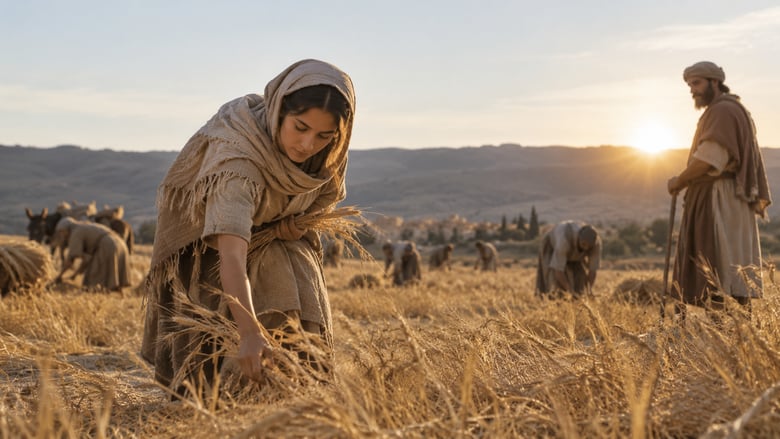
Ruth and Boaz
I truly enjoyed taking a slow, quiet read in The Word today;
HOLDING the Bible. I want to not rely too much on recorded verse, recorded prayer - although oh it supports me and my day. walking with my healing, keeping me current and truly focused on Him, working with me, walking with me, loving me - but - Him First.
So, holding the bible today, avoiding any concerns about Which Bible? Is it the Right Bible?
How do we know...
Not today Satan.
Today, I sat with my NKJV and just read. And then watched studies on it.
What a story. Ruth.
The Book of Ruth.
It started as a slow quiet read and hit a crescendo of deeper understanding.
Always with the quick hearing of the story... always with the quick assesment that I was like a Ruth on my best days.
That may be true.
I love to identify with her loyalty, and her honesty within her boldness.
YES indeed.... I can also see maturity in my reading now too.....
(Beyond the lingering feminism.... WHICH woman of the Bible are You.... is a real movement. Tragic.)
Boaz is a super hero.
Plays gently and fiercly by the book.
By the Law.
Honorable in an ancient way that can be difficult to translate readily into modern times.
I learned I am a lot like Boaz, too.
I also learned how much, again, I love to hold the Bible and read the Bible.
The shift is from “Which character am I?” to “What is God revealing about Himself, covenant faithfulness, redemption, and the kind of people His presence forms?”
And The Book of Ruth is extraordinarily rich when read that way.
Deeper into Ruth.
BOAZ!
He is not merely the romantic reward at the end of Ruth's faithfulness.
He is a man whose strength is governed by God's law.
He has power.
Ruth does not.
He has land.
She does not.
He has standing in the community.
She is a Moabite widow.
He could exploit that imbalance—and instead, almost every time Boaz has an opportunity to use power for himself, he uses it to protect someone with less power.
I love that!
That is significant.
I want to be that too.
Ruth 2: Boaz doesn't merely obey the Law—he understands its heart
Leviticus 19:9–10
(then I re-read Ruth 2 again... I LOVE that I am starting to connect and remember things, although I did have to search!)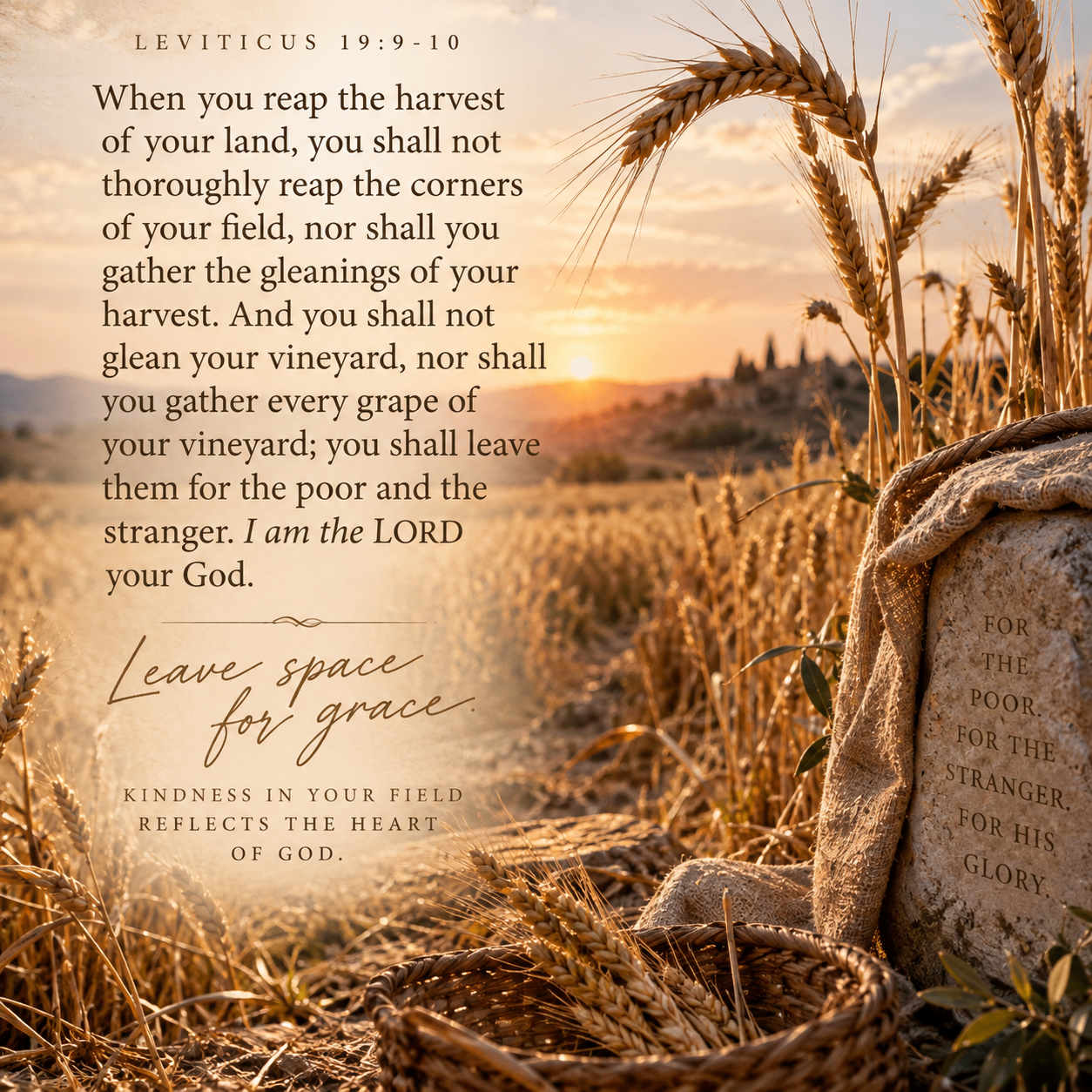
God had commanded landowners not to harvest every last bit of their fields. The edges and overlooked grain were to remain for the poor, the widow, the stranger.
Boaz does that—but then goes further.
He tells Ruth to remain in his field.
He orders the young men not to touch her.
He gives her access to water.
He invites her to his table.
That's beautiful because Boaz doesn't use the Law as a ceiling:
What is the minimum God requires of me?
He uses it as a window into God's character:
If this is what God cares about, how generously can I embody it?
Ruth's loyalty may resonate with me—but perhaps Boaz's instinct does too:
There is someone standing outside the protection of the community.
Bring them in. Give them a place. Protect their dignity. Help them build a life.
That is considerably deeper than “Which woman of the Bible are you?”
I too am outside the protection of community. It troubled me just recently...
And Ruth isn't simply the heroine, either
Ruth's great declaration in Ruth 1:16–17
I originally treated almost like romantic poetry:
“Wherever you go, I will go…”
But I re-read the whole declaration, with new eyes and intention:
The climax isn't Naomi or human loyalty.....
It's:
“Your God, my God.”
Ruth isn't simply choosing a woman she loves.
She's crossing over.
Moab → Israel.
Old identity → covenant people.
Old gods → Yahweh.
Security → uncertainty.
Known world → faith.
And she makes that commitment before she knows there will be a Boaz.
WOW!
That's critical to me, that faith.
She isn't faithful because she has seen how the story ends.
She walks into Bethlehem poor, widowed, foreign and with absolutely no guarantee that faithfulness will produce the outcome that we.... already know is coming.
I walk my life this way now: Although honestly blessed by all accounts! I am more and more aware of choosing to walk in faith.
Without Fear, with faith.
Daily Bread, with belief.
Choose Joy, with gusto.
Yes... We know Chapter 4 while Ruth is living Chapter 1.
But she doesn't.
That makes her faithfulness so much more formidable to me.
It reminds me of Pat's declaration over me, and the extraction of my promise to follow "That Faith of Yours... that is Your Future."
Then there is Naomi
Can't skip her!
In some ways, Naomi may be the most psychologically sophisticated person in the book.
Right?
She leaves Bethlehem during famine.
Her husband dies. Both sons die.
She comes home with Ruth and says:
“Do not call me Naomi; call me Mara…”
Naomi means pleasant.
Mara means bitter.
And then she says something startling:
“I went out full, and the LORD has brought me home again empty.”
— Ruth 1:21 NKJV
Except she's standing there with Ruth beside her.
Naomi believes she's returned empty..... while God's provision is literally standing next to her. That's worth sitting with. It just impresses me!
Sometimes God's answer has already entered the story while the suffering person is still incapable of recognizing it as an answer.
Slowly I am growing beyond this.
Ever so slowly.
And then: God doesn't rebuke Naomi out of the book.
Her bitterness gets recorded.
Her grief gets recorded.
Her accusation gets recorded.
Like the need to share, to record the anger or frustration human to human... all while knowing it will pass. Knowing "But God".
But God!
Then God quietly writes the next chapter.
As He does, always.
By Ruth 4, the women are telling Naomi that the Lord has not left her without a redeemer.
The woman who announced herself empty ends the story holding a child.
But Boaz takes you somewhere even deeper: redemption
One of the studies invited me to look carefully at the language of kinsman-redeemer (go'el).
Boaz wants Ruth.
But wanting her isn't sufficient.
There is a nearer relative with a prior legal claim.
And this is exactly why I describe Boaz as one who Plays Gently and Fiercely by the Book. By the Law.
Boaz does not manipulate the law because he believes his desired outcome is righteous.
He goes to the gate.
He gathers the elders.
He presents the matter publicly.
He gives the nearer redeemer his rightful opportunity.
And when that man initially says, essentially, I'll redeem it, Boaz doesn't cheat him.
No, he lays out the whole cost.
And that changes the man's answer.
Boaz then assumes the cost himself.
HERE! There is something profoundly biblical here:
Real redemption costs the redeemer something.
Boaz...is not Jesus.... but it all points forward
Someone unable to restore her own position.
A redeemer who possesses the capacity to redeem.
A legitimate cost.
A public act.
A restored inheritance.
An outsider brought into the covenant family.
Then eventually—David.
Then ultimately—Christ.
Then.....after this intimate little story about two widows, some barley and an honorable landowner, as I have read so many times before.... suddenly:
Obed → Jesse → David.
WOW.
God has been doing something vastly larger than any character could see.
Can I JUST WALK IN THAT PLEASE.... HE is GOD and I am Not.
And then I re-open the usually overly trying geneology in Matthew 1....
There she is - Ruth.
The Moabite widow standing in the genealogy of Jesus Christ.
Right There.
That is the scale of this entire story.
SO I can see myself growing, changing.
No Longer am I asking.....“Am I Ruth or am I Boaz?”
But:
“What does faithfulness look like when I cannot see what God is building from it?”
Ruth couldn't see David.
Boaz couldn't see David.
Naomi couldn't see David.
None of them could see Bethlehem centuries later.
None could see the genealogy Matthew would write.
WOW, really my mind is blowing open, and I am undone by You, Lord.
They could only see the next faithful thing in front of them.
Daily Bread.
Ruth could glean.
Boaz could protect.
Naomi could advise.
Boaz could go to the gate.
Ruth could wait.
And God could handle the generations.
That, to me, is one of the magnificent things about The Book and Story of Ruth:
They are responsible for faithfulness.
God is responsible for the size of the story.
Recorded Scripture can accompany me.
Bible studies can illuminate things.
Teachers can point things out.
Conversations can illuminate.
But none of them should replace the extraordinarily simple practice I rediscovered today:
Bible open.
Read slowly.
Notice what is actually there.
Ask what it tells me about God.
Follow the cross-references.
Stay awhile.
Lord, what are You showing me here?
Comments (0)
Join the conversation
Be the first to share your thoughts on this post